
Description
Moyra colour palette – Colour wheel is a practical tool that quickly and easily teaches you how to mix colour pigments correctly: Which colours can be combined to achieve the desired shade? Which pigments go well together and which contrast best? How to lighten or darken a given shade? Learn the principles of colour theory, thanks to the Moyra Colour wheel.
Description:
Colour wheel Side A:
Shows what color you get by mixing 2 colours (one on the outer circle, one on the inner circle).
Colour definitions:
- Primary colours: yellow, red, blue. These colours cannot be made by mixing, so they are primary colours.
- Secondary colors: green, orange, purple, which are made by mixing two primary colours.
- Tertiary (middle) colours: yellow-orange, red-orange, blue-violet, red-violet, blue-green, yellow-green, which are made by mixing a primary and a secondary colour.
- Warm colours: red, orange, yellow.
- Cool colours: green, blue, purple.
- Hue
- Hue: Colour + white
- Tone: Colour + gray
- Hue: Colour + black
- The main colour in a colour mix
- Neutral gray: a combination of black and white
- The strength of the colour or dullness
- The lightness or darkness of the colour
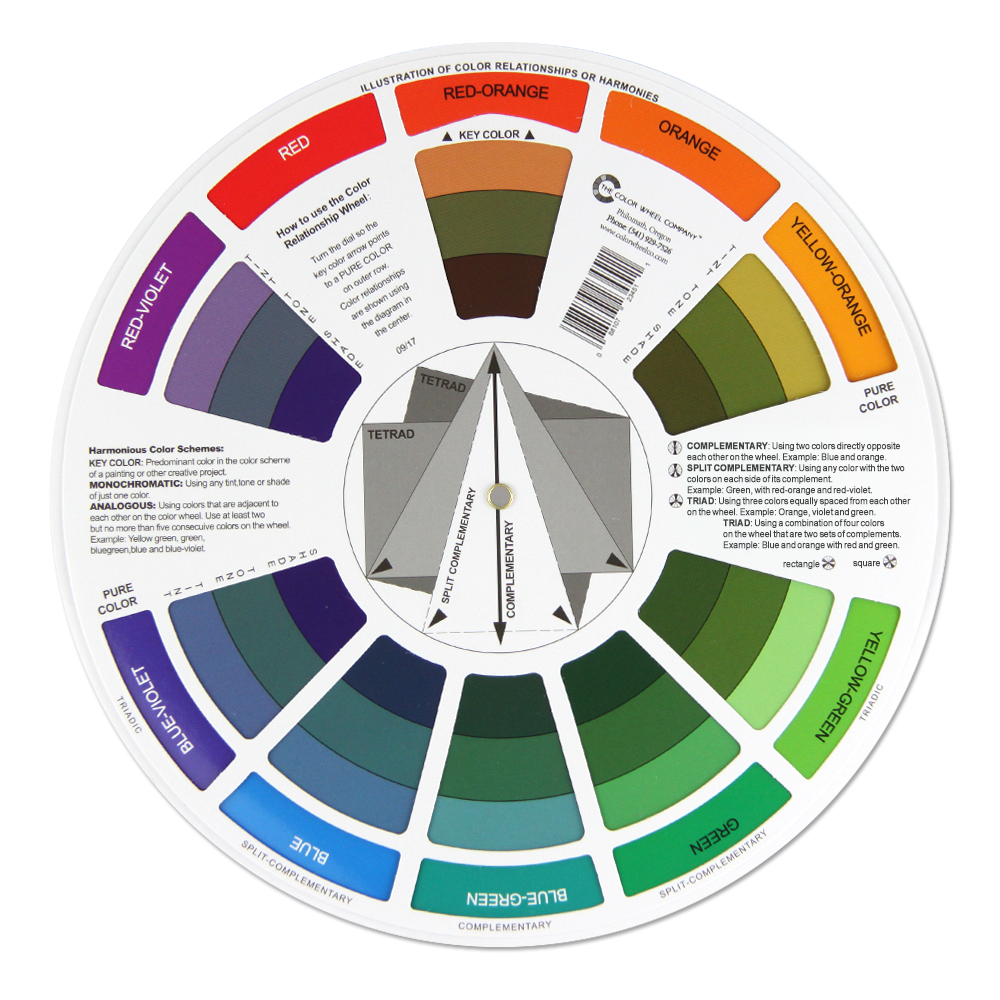
Color Wheel Side B:
To use the color wheel for mixing colors, turn the wheel so that the arrow points to the selected pure color on the outer circle. The corresponding color combinations are shown in the image in the center of the circle.
- Complementary (opposite colours opposite each other)
- Complementary division (immediately adjacent colours next to the complementary colour)
- Triad: Harmonious 3 colours (colours at the vertices of a triangle)
- Tetrad: 4 colours (2 complementary sets)
Colour harmony:
- Monochromatic (combined colours from one slice of the colour wheel)
- Analogous (at least two, but no more than five adjacent colours in the circle that harmonise with each other.)